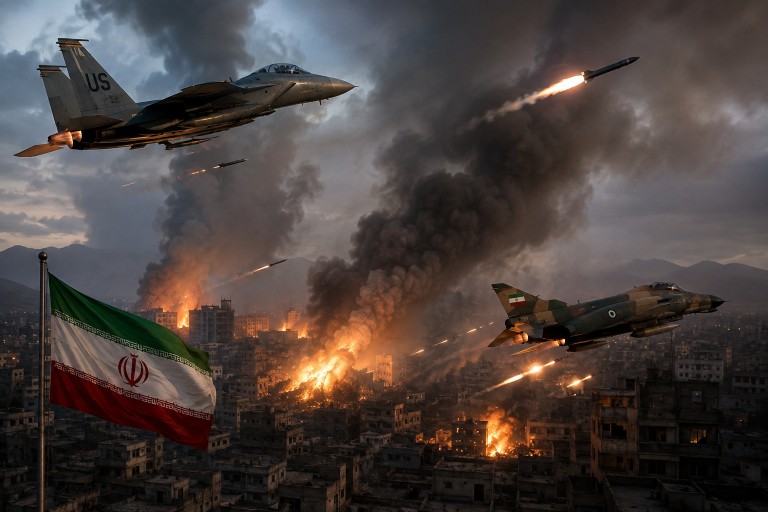
Recent hostilities between the United States and Iran have led to heightened tensions in the Middle East, as both nations exchanged a series of airstrikes. The U.S. military conducted new attacks against sites connected to Iran’s Islamic Revolutionary Guard Corps (IRGC), citing these actions as a response to attempted assaults on commercial vessels in the Strait of Hormuz and threats against American personnel in the region.
Iran retaliated with missile and drone strikes targeting U.S. interests across several countries, including Jordan, Bahrain, Kuwait, and Iraq. In Jordan, the military successfully intercepted ten ballistic missiles launched from Iran, while three others landed in remote areas without causing any casualties or confirmed hits on a U.S. military training facility. Iran also claimed responsibility for strikes near a U.S. base close to Erbil in Iraq, with additional missile and drone activity reported in Kuwait, and air-raid sirens blaring in Bahrain.
This latest exchange has amplified concerns over the safety of the Strait of Hormuz, a vital corridor for global oil shipments. The situation has already led to a rise in oil prices, and Iran has issued warnings that it could obstruct oil exports from the Gulf if the U.S. increases military or economic pressure. Iranian officials criticized the recent U.S. strikes, with President Masoud Pezeshkian stating Tehran would be willing to reciprocate if the U.S. does not honor previous commitments aimed at de-escalating the conflict.
Tensions remain elevated, with both nations warning that further aggression could lead to more severe retaliation. U.S. President Donald Trump has threatened a significantly stronger response should Iran continue its attacks, while Iranian authorities have declared they will employ both military and diplomatic strategies to protect their interests. The resurgence of military actions follows a period where the conflict had shifted towards sanctions and economic pressure rather than direct military confrontation.
The recent strikes have sparked fears that these containment efforts could fall apart, potentially plunging the region back into sustained military conflict. As the situation develops, international observers watch closely, concerned about the implications for regional stability and global economic impacts.